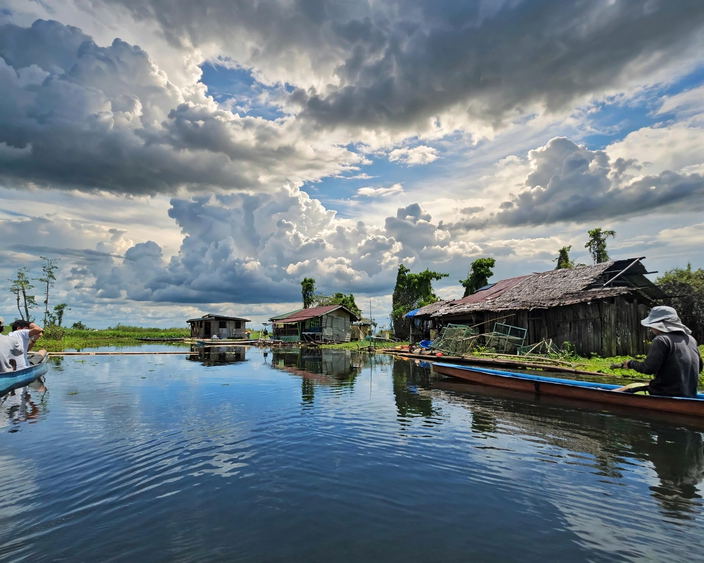
The Manobo families of Sitio Panlabuhan do not worry about floods the way most of us do. Their houses sit on bundles of hardwood logs lashed together under the floor, so when the Agusan Marsh rises after weeks of rain, the homes simply lift with it. When the water drops, they settle back down. It is one of the few places in the country where a whole village has been built to float.
Getting there takes some planning. The village lies deep inside the Agusan Marsh Wildlife Sanctuary in Agusan del Sur, reachable only by boat, and visits run as a guided overnight tour arranged through the sanctuary office in Bunawan. You cannot just turn up at a pier and hire a ride in. The short version: book ahead with the Protected Area Management Office, get to Bunawan by early morning, and plan on one night on the water.
Below is what the marsh is, how the two-day tour runs, how to reach the jump-off point, and what to pack and expect once you are out there.
The marsh in a few facts
The Agusan Marsh covers roughly 14,800 hectares of swamp forest, river channels and shallow lakes spread across six towns: Bunawan, La Paz, Loreto, Rosario, San Francisco and Talacogon. It soaks up floodwater from the Agusan River basin, which is why its size on any given day depends on the season.
It became a wildlife sanctuary in 1996, was listed as a wetland of international importance under the Ramsar Convention in 1999, and received stronger legal protection under the expanded protected areas law in 2018. More than 200 bird species use it for at least part of the year, including the Philippine duck and the purple heron, and saltwater crocodiles still live in its channels.
That last detail is how many Filipinos first heard of the place. Lolong, a saltwater crocodile measuring about 6.17 meters, was captured near Bunawan in 2011 and was later recognized as the largest crocodile ever kept in captivity. He died in 2013, but the town still trades on the story.
Who lives at Lake Panlabuhan
Panlabuhan belongs to the town of Loreto and sits within the ancestral domain of the Manobo, who have fished these waters for generations. The Umajam River is the usual way in. The village has been opening up to guests since the mid-2010s, and in 2025 its community-run tourism program placed first runner-up for best practices in community-based tourism at the ATOP National Tourism Pearl Awards.
Treat the trip as a visit to someone's home rather than an attraction. The tour opens with the panawagtawag, a ritual in which the community asks permission for your stay. Follow the lead of your guide during it, ask before photographing people, and keep your voice down at night. Many traditions are still practiced here, though residents generally dress in everyday clothes rather than ceremonial attire.
How the overnight tour runs
The provincial tour is a two-day, one-night trip that starts and ends at the PAMO and IPAS complex in Bunawan. A typical schedule looks like this:
- Day 1, 8:00 a.m.: registration and a short environmental briefing at the office.
- 9:00 a.m.: boat transfer through the channels to Lake Panlabuhan, arriving around 11:00 a.m.
- Midday: welcome ritual, then lunch, often binaga, which is grilled mudfish.
- Afternoon: a ride on a bauto, the local paddle boat, for birdwatching and the sunset.
- Day 2, 5:30 a.m.: sunrise boat ride, then breakfast and some free time.
- 9:00 a.m.: departure, reaching Bunawan around 10:00 a.m.
Boats range from motorized pumpboats to wooden canoes, depending on the leg and the water level. The two-hour ride in is a big part of the experience: the channels narrow, the forest closes in, and then the water opens up into lakes dotted with lilies and hyacinth.
Booking and costs
Arrange the tour before you travel. The Agusan Marsh Protected Area Management Office handles visits and can be reached at pasuamws@gmail.com, on 0930 804 4113, or through its Facebook page. The Provincial Tourism Office at the ADS Heritage Center in Prosperidad (tourism@pgas.ph) can also help, especially if you want to add other stops in the province.
Fees and package rates are not posted publicly and tend to change, so ask for a full breakdown when you book: the environmental or entrance fee, boat rental, the guide, meals, the overnight stay and any community contribution. Bring enough cash to cover all of it. There are no ATMs on the marsh, and you should not count on paying electronically once you leave Bunawan.
Getting to Bunawan
Bunawan sits on the national highway that runs between Butuan and Davao, so buses on that route pass through town. Ask the conductor to drop you in Bunawan, then take a tricycle to the sanctuary office. Butuan has the nearest commercial airport. Coming from Davao City by private car takes about four hours.
Because registration starts at 8:00 a.m., most visitors spend the night before somewhere along the highway rather than trying to arrive on an overnight bus. Butuan has the widest range of hotels; towns closer to Bunawan, such as San Francisco, have smaller options. If Mindanao is new to you, read our note on whether Mindanao is safe to travel, which covers advisories and how to check them before you go.
When to go
This side of Mindanao has no real dry season. Rain falls through most of the year, with the heaviest stretch usually from about November to February. High water fills the lakes and makes the marsh look its most dramatic, but it can also slow boat travel or lead the office to adjust trips, so check conditions a few days before you leave. Birdwatchers often aim for the cooler months, when migratory species join the resident birds. Whatever the month, plan for heat, humidity and a sudden downpour.
What to pack and expect
Accommodation is basic: a mattress or mat, a blanket and a mosquito net in a simple floating house. Lighting comes from solar panels, and phone signal can be patchy, so download offline maps and charge a power bank before you set out. Toilet facilities are simple.
- Insect repellent, a hat and sunscreen
- A light rain jacket and a dry bag for your phone and camera
- Binoculars if you want to make the most of the birdlife
- Quick-dry clothes and sandals you can get wet
- Medicines, snacks and drinking water for the boat ride
- Cash in small bills
Stay seated in the boats, keep your hands out of the water, and take your trash back to Bunawan with you. The crocodiles are rarely seen, but the guides know where they are and will tell you where not to dangle your feet.
Adding more of Caraga
If you have more days, the region rewards a longer loop. Surigao del Sur lies to the east, where the blue water of the Hinatuan Enchanted River makes a striking contrast with the tea-colored lakes of the marsh. Farther north, Sohoton Cove in Bucas Grande offers another boat-based trip through lagoons and caves.
Still, the marsh deserves a trip of its own. Book ahead, arrive in Bunawan early, and leave room for a slow afternoon on the water. The quiet out there is the reason to go.



Comments
No comments yet. Been here recently? Share a tip or ask a question.
Leave a Reply