You can see Iloilo City's three main heritage areas in one day: Calle Real for trade, Jaro for faith, and the Iloilo River Esplanade for the modern city. The order matters less than the idea behind it, because each place makes more sense once you know what paid for it.
Trade money built the commercial street, belief and a few stubborn bell towers built Jaro, and a decision to open the river to people built the Esplanade. Walk them in that sequence and you cover about a century and a half of the city, with a long lunch in the middle.
Distances are short, but the midday heat is not, so this guide is built around a morning, a midday and a late-afternoon stop.
Calle Real: Where the Trade Money Went
Calle Real is officially J.M. Basa Street, renamed for the businessman and Rizal associate José María Basa, though most Ilonggos kept the old name. It runs only about 0.75 kilometres, yet it was Iloilo's main commercial street under Spain and became a row of upmarket shops selling imported goods under the Americans. A city ordinance protects the wider zone, and the National Historical Commission of the Philippines (NHCP) recognises it as a heritage district.
The buildings carry the dates. The Javellana Building went up in 1922, the Celso Ledesma Building in 1923, and the Eusebio Villanueva Building in 1927, which began life as a hotel and was restored in 2012. Facing Plaza Libertad, the Iloilo Masonic Temple was completed in 1928, became a Japanese army headquarters during the war, and is now a National Historical Landmark.
Spend your longest stop at the Museum of Philippine Economic History. It occupies the Elizalde Building, put up in 1905 as a branch of the trading firm Ynchausti y Compañía, and it opened as a museum on 11 February 2019. The ground floor explains the building and Iloilo's rise as a trading centre, while the upper floor has galleries on industries such as sugar, rice, pottery, textiles, tobacco, abaca and coconut. Check opening hours and any entrance fee with the NHCP or the museum's official page before you go.
Calle Real is a working street, not a preserved set. Much of the city's business has moved to Mandurriao, so the old district is quieter than it once was, and the overhead wires were buried by early 2025, which leaves the facades easier to see and photograph. Go in the morning, look above the shop signs, and allow up to two hours with the museum.
Jaro: The Cathedral and the Tower Across the Street
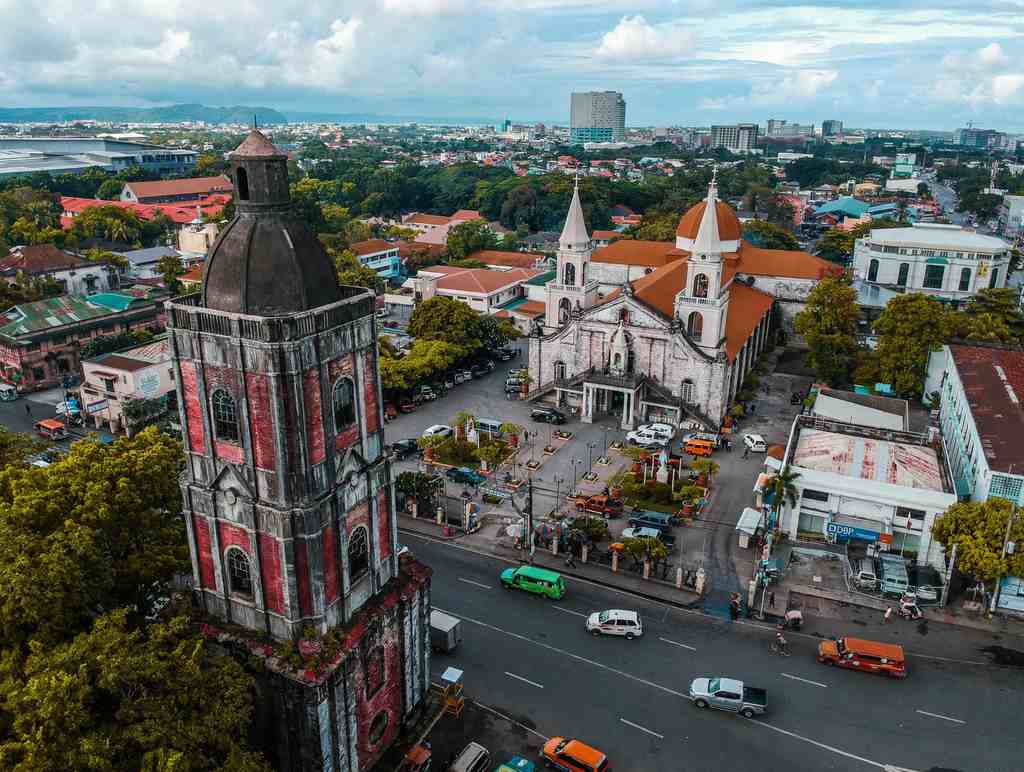
Jaro was a separate town for much of its history, and its plaza still feels like one. The first stone church here was built between 1742 and 1744, but earthquakes in 1787 and later damaged it, so the parish raised a new cathedral on another site. Work on the current building began in 1869 and it was consecrated in 1874. In February 2012 it was declared the National Shrine of Our Lady of Candles.
The bell tower stands apart from the church, on the other side of a busy road, a layout more familiar from Ilocos than the Visayas. The belfry was completed in 1744 and rises about 29 metres in brick and limestone. The 1948 earthquake brought down its upper floors. It became a National Historical Landmark in 1984, and after a restoration by the NHCP its bells rang again on 27 November 2022, the first time in 74 years. When it reopened, it was not open to visitors, so plan to enjoy it from the plaza and ask at the cathedral office if you hope to go up.
For a look inside a family home, the Lopez Heritage House, widely known as Nelly's Garden, was built by Don Vicente Lopez and Doña Elena Hofileña and finished by 1928. It sits on about four hectares and is open to the public for tours and events. Because it doubles as an event venue, confirm the day's access before heading over. Other mansions nearby are private, so view them from the street.
The cathedral is an active church. Cover your shoulders, silence your phone and skip flash during services. The feast of Our Lady of Candles falls on 2 February, and the city prepared for up to 18,000 devotees at the 2026 celebration, with road closures around the plaza. If you want space to look around, choose another week. If you are already planning a January trip for the festival, our Dinagyang 2027 guide covers the dates so far.
To get there from the old downtown, take a taxi or ride-hailing car with the pin set to Jaro Plaza, or board a Jaro-bound jeepney and confirm with the driver that it passes the cathedral.
Lunch Between Districts: La Paz or Molo
Jaro to the river is a natural lunch gap, and Iloilo's best-known bowls are close to the route. La Paz public market is the home of La Paz batchoy, and the stalls are liveliest early. Molo, southwest of the downtown, is the place for pancit molo, a clear broth with pork dumplings. Molo's church is worth a glance too, because its saints are famously female, a theme the Jaro cathedral answers with a row of male saints. Our Iloilo and Guimaras food trip guide covers what to order and where.
The Iloilo River Esplanade: A River Given Back
The Esplanade is the youngest stop and the one locals use most. Landscape architect Paulo Alcazaren designed it, and the first phase, a 1.26-kilometre stretch in Mandurriao between Carpenter Bridge and Iloilo Bridge, opened on 18 August 2012 at a cost of ₱58.7 million. Later phases funded by the Department of Public Works and Highways, from 2017 to 2020, cost about ₱1.12 billion. It won a Galing Pook Award in 2018.
It is not one park but a chain of sections linked by bridges along both banks, so you choose a stretch. The sections around Carpenter Bridge and Iloilo Bridge, in Mandurriao and Molo, make an easy loop. The one in the City Proper, between Iloilo Bridge and Jalandoni Bridge, is handy if you want to finish close to Calle Real. Look for the mangroves along the water and public art such as the Dinagyang mural.
Iloilo Sunset Boulevard, opened in January 2025, adds a 4.99-kilometre road with a 1.58-kilometre esplanade extension for a different stretch of riverfront. Late afternoon into evening is the easiest time to walk, when the heat eases. Bring water either way.
The One-Day Route
One day, three districts
Calle Real to the Esplanade
Start8:30 a.m.FinishAround duskBetween districtsTaxi or jeepney
-
8:30 a.m.
Calle Real and the museum
Walk the stretch between Plaza Libertad and Plazoleta Gay, then spend your longest stop at the Museum of Philippine Economic History.
-
11:30 a.m.
Jaro Plaza
Take a taxi or jeepney to the plaza for the cathedral, the belfry and, if it is open that day, Nelly's Garden.
-
1:30 p.m.
Lunch and a rest
Batchoy in La Paz or pancit molo in Molo, then a short break out of the sun.
-
4:30 p.m.
The Esplanade
Pick a section, walk until dusk, and have dinner by the river or back downtown.
Pack light: wear comfortable shoes, carry small bills for jeepney fares, and keep the schedule loose.
Staying another day? The Gigantes Islands are a boat trip away, and our Gigantes guide explains the route.
Iloilo does not stage its past. The street still trades, the cathedral still holds Mass, and the river path is a place to walk, not a monument. That is what makes a single day here feel like three different cities.
Photo: Aerial View of City Buildings by Janssen Panizales on Pexels.
Comments
No comments yet. Been here recently? Share a tip or ask a question.
Leave a Reply