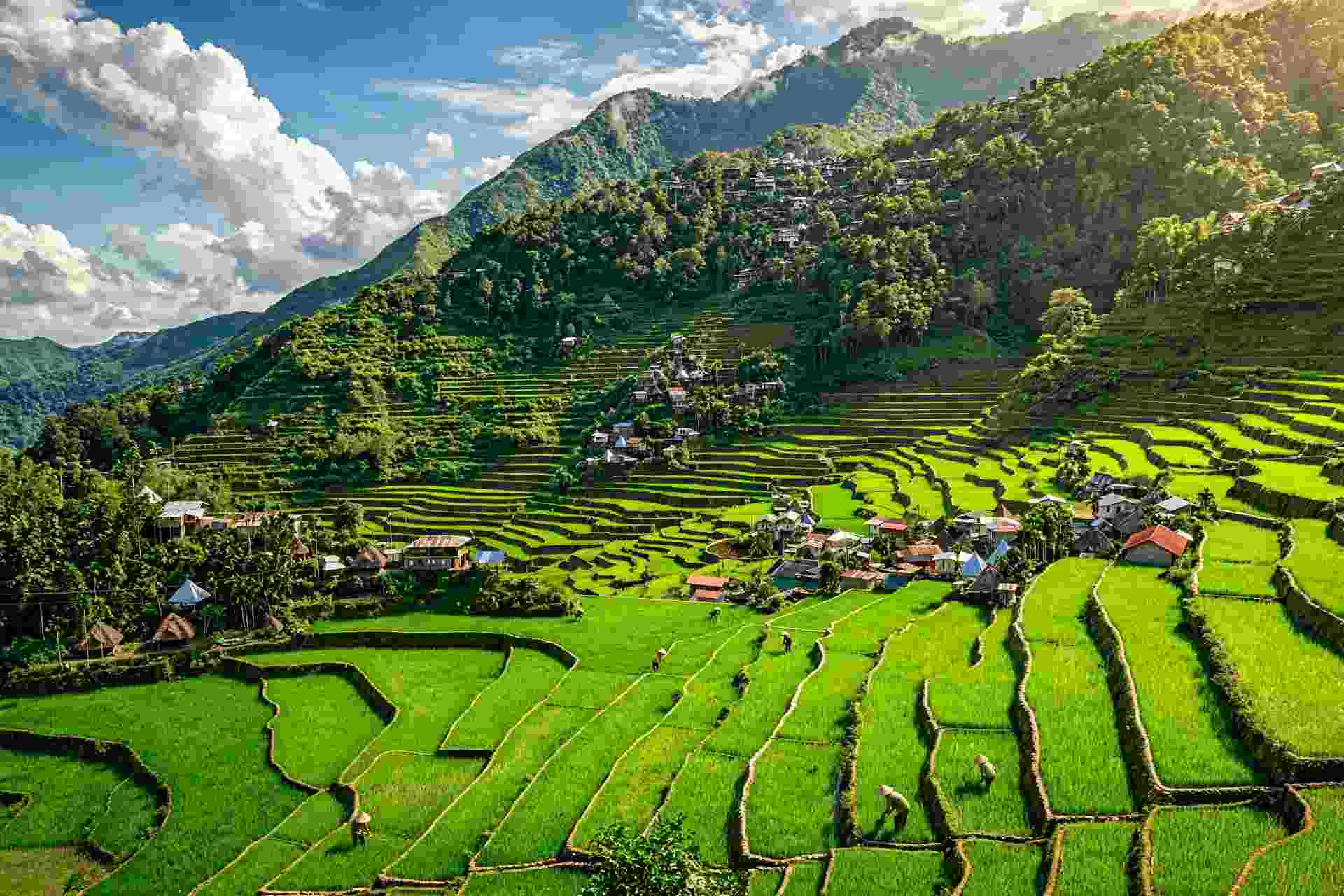
Banaue and Batad are the terraces most people picture when they hear the words "rice terraces." Getting there takes a long day, so plan for it. You fly to Manila, ride an overnight bus into the Cordillera, then finish the last stretch by tricycle and on foot. The payoff is a set of terraces farmed by the same families for generations, stone walls that hold steep hillsides together, and mountain mornings much colder than most Visayan travelers expect.
Banaue town is the easier base. The main viewpoint sits a short ride from the town center and gives you the broad panorama. Batad is the quieter, steeper option: a village set inside a bowl of terraces, reached only on foot from the road. Both belong to the Rice Terraces of the Philippine Cordilleras, a UNESCO World Heritage Site inscribed in 1995, so it pays to learn the local rules before you start walking.
Set your expectations for the terrain too. The paths are narrow and turn slippery after rain. The walk suits anyone who can handle steady uphill climbing and does not mind stopping often to rest and look around.
Getting there
There are no direct flights to Banaue. Most travelers fly into Manila and leave a generous margin before their bus. Manila traffic between the airport and the bus terminals is unpredictable, so do not plan to make the connection with minutes to spare.
Ohayami Transit leaves from the corner of Fajardo Street and Lacson Avenue in Sampaloc, near UST, with departures starting around 8 p.m. Dangwa Transit runs an evening trip from Florida Cubao Terminal near Kamias, taking about eight hours. Coda Lines leaves from Cubao HM Terminal and takes considerably longer, because its buses continue on to Sagada. Fares and schedules shift, so confirm with the operator or a booking site a few days before you travel.
Ohayami also runs from Baguio, departing near Burnham Park and taking seven to eight hours. If you want a city stop first, our Baguio places to visit guide covers what to see before you head north.
The Banaue viewpoint: the easy panorama
Most tour vans stop at the main viewpoint, and it is the quickest way to see the terraces spread across the slopes. Expect a few viewing decks, souvenir stalls, and locals in traditional dress who offer photos. A small tip is customary if you pose, so keep small bills handy. Early morning usually brings clearer air before clouds build up over the valley.
Banaue charges an environmental fee of PHP 20 per person under a municipal ordinance meant to support eco-tourism and terrace preservation. Record your arrival at the Municipal Tourism Center in town, which also arranges licensed guides for the walks.
Batad: the amphitheater of terraces
Batad village sits inside a curved bowl of terraces, with houses along the upper rim and paddies dropping down in stone-walled steps. There is no road into the village itself. You get off at the junction and walk down. The descent is steep but short. The climb back up is the part that tests your legs, so save some energy and water for it.
Get your guide through the Tourism Center before you head up. Official advice recommends a licensed local guide for safety and to support the community, and guides know which walls are safe to step on. Guide rates vary by route. Travel sites have listed around PHP 1,200 per group for the village and Tappiya Falls, so confirm the current posted rate at the center before agreeing to anything.
Tappiya Falls and the longer walk
Tappiya Falls is roughly an hour's walk from the village, through rice dikes and forest. Treat the full round trip as a half-day outing and wear shoes with grip rather than slippers. Bring at least a liter of water. After heavy rain the current in the pool becomes strong, so skip the swim and enjoy the falls from the rocks, and ask your guide whether the water is safe that day.
Where to stay
Lodging in Batad is mostly family-run inns and homestays with simple fan rooms, shared bathrooms, and no air-conditioning. Some listings put basic rooms from around PHP 250 per person a night, and weekend and holiday rates run higher. Power is limited and the signal is weak, so pack a headlamp, a power bank, and enough cash for meals and the homestay.
In Banaue town you get hot water, sit-down restaurants, and easier access to bus stops. For a single night, that is the better choice. Choose Batad when you want to see the terraces before the day visitors arrive and after they leave.
When to go
The dry season runs roughly from December to June, which keeps muddy trails in check. April and May bring the greenest terraces, when newly planted paddies cover the slopes. The harvest turns the fields gold in the later months, usually around July to September, though timing shifts from village to village. June through October is the wetter stretch, when trails get slick and waterfall swims become risky.
Is it worth the trip?
Yes, if you have three or four days and can handle an overnight bus. Banaue gives you a clear view in a single morning. Batad rewards a night in the village, when the terraces are quieter and the cold settles into the valley. Pack for mountain weather, bring more cash than you think you need, and build a buffer into your return bus.
If the cold mountain towns appeal, our Sagada caves and hanging coffins guide covers the next stop in the Cordillera.