Mayon Volcano rises 2,463 meters above Albay in Bicol and keeps the outline most volcanoes lose with age: a smooth, almost perfectly symmetrical cone. It is also the most active volcano in the country, with more than 50 recorded eruptions since 1616. Beautiful and unpredictable is a big part of why people plan whole trips around it.
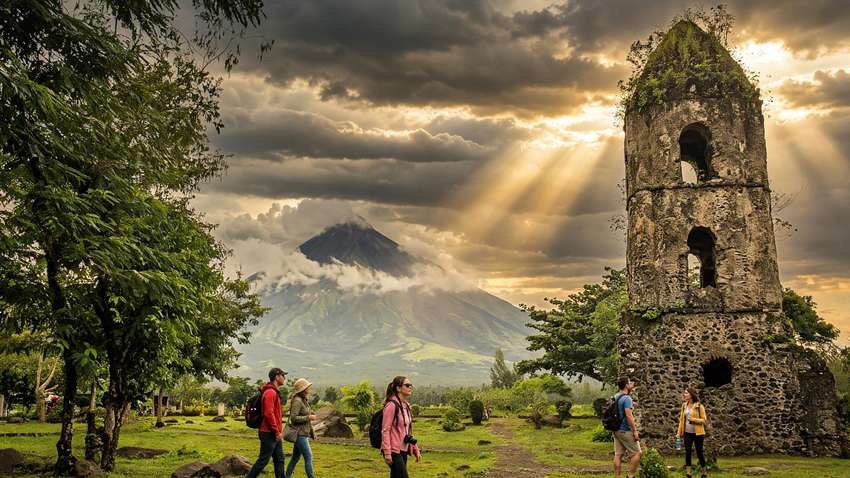
The classic place to see it is Cagsawa Ruins Park in Barangay Busay, Daraga. The bell tower standing there is what remains of the Cagsawa Church, buried when Mayon erupted violently on February 1, 1814. The town was destroyed and more than 1,200 people died. Mayon sits directly behind the belfry, which is why that pairing ended up on so many Bicol postcards.
This guide covers what the park costs, how ATV rides across the lava fields are priced, how to reach Legazpi, which months give you the best odds of a clear cone, and what to do on the days Mayon decides to hide.
Go early, because Mayon keeps office hours
Mayon is a stratovolcano. Frequent eruptions lay down lava, ash and loose rock in even layers around one central vent, and because it erupts often, erosion never gets the time to chew the cone into something lumpy. The shape you see is the result of the volcano repeatedly rebuilding itself.
The cone shows best in the morning. By late morning cloud often settles over the summit, so aim to be at Cagsawa between 7 and 8 AM. Locals call the mountain Daragang Magayon, the beautiful lady, and the nickname suits her: she shows herself when she feels like it. If your schedule allows, give yourself two mornings in Albay rather than betting everything on one.
Legazpi has its own viewpoint too. Lignon Hill Nature Park sits 156 meters above the city, with 360-degree views and a zipline, and it works well for a late-afternoon look at the cone.
Cagsawa Ruins Park: fees, hours and what is inside
The park is run by the municipality of Daraga and it is small, a garden with the belfry, a little museum and souvenir stalls. Adults have recently paid PHP 30 to 45 at the gate, seniors and PWD around PHP 30, and students and children PHP 10 to 20. Parking runs about PHP 20 for a motorcycle or tricycle and PHP 30 for a car. Fees change, so confirm at the gate. The park is generally open from around 8 AM to 6 PM, though the ATV operators along the access road start earlier.
You cannot climb the bell tower, but you can walk around it and read the markers about the 1814 eruption. There is a viewing area with benches facing the cone, a museum with church artifacts and an eruption timeline, and shops selling abaca crafts, pili candy and shirts. Thirty to sixty minutes is enough for sightseeing, and two hours if you want a slow photo session and the museum. The paths are cemented, but the garden gets uneven after rain.
You do not need a guide for the history, since the markers cover it. If someone offers to photograph you for PHP 100 to 200, agree on the price before the first shot. Pili nuts here tend to cost more than at the Legazpi market, so compare before you stock up.
ATV rides across the lava fields
The eruptions of 2006 and 2018 left wide fields of lahar and hardened lava at the foot of Mayon, and ATV rides are now the main activity there. Operators cluster along the Cagsawa Ruins road in Daraga and around Pawa in Legazpi.
The Green Lava trail takes about two to two and a half hours through grassland and forest paths, and it is the gentler, less dusty option for first-timers. Expect roughly PHP 1,500 to 3,000 per person depending on the operator. The Black Lava trail runs two to three hours to the 2006 lava formation, rockier and with the wall of black rock people photograph, at about PHP 1,850 to 2,800. Longer advanced routes to the higher lava front take three to four hours at roughly PHP 2,500 to 4,500, and full-day combinations of four hours or more can reach PHP 4,500 to 7,500. Rates differ by operator and season, so treat these as ranges.
Prices usually include the ATV, a helmet, a guide who also doubles as your photographer, and an environmental fee. Wear closed shoes and clothes you do not mind getting dusty, and bring a small dry bag for your phone. Tipping the guide PHP 100 to 200 for good service is common. Book a day ahead through your hotel or an accredited operator, take the 6:30 to 9 AM slot for cooler air and a clearer mountain, and check the brakes, the helmet strap and whether insurance is included. The ride is a poor fit for pregnant travelers and anyone with back problems, and operators set their own rules for children.
Getting to Albay
The gateway is Legazpi, and the airport is Bicol International Airport (DRP) in Daraga, which opened in 2021 and replaced the old Legazpi airport. Most travelers coming from the Visayas or Mindanao connect through Manila. Manila to Legazpi takes about an hour and flies daily, with one-way fares from roughly PHP 1,500 to 4,000. A few cities have direct flights on certain days of the week, which cut the trip to a little over an hour, but check the current schedule before building plans around one.
If you connect in Manila, leave four to six hours between flights or sleep over. Our Manila 24-hour stopover guide is useful if you pick the overnight option. Take the earliest flight to Legazpi you can find, because landing in the morning gives you a decent chance at the cone on arrival. The Manila to Legazpi bus takes 10 to 12 hours and costs about PHP 1,200 to 2,000, which is scenic but only sensible if you have time to spare.
From the airport, a tricycle to Cagsawa runs about PHP 150 to 300, and a van for a group costs roughly PHP 500 to 800. Ride-hailing coverage is thin in Legazpi, so plan on tricycles and taxis.
What a weekend costs
A guesthouse in Legazpi runs about PHP 1,200 to 2,000 a night and a mid-range hotel PHP 2,500 to 4,500. Meals are PHP 200 to 400 per person, and the local cuisine is worth the stomach space: Bicol Express, laing and pili ice cream. Side stops are cheap, with Sumlang Lake around PHP 100 and Lignon Hill PHP 30 to 50 for entry, plus PHP 300 to 400 if you add the zipline.
A sample two-day, one-night trip with return flights around PHP 6,000, a PHP 2,000 hotel, PHP 1,000 in local transport, one ATV ride at PHP 2,000 and PHP 1,500 for food comes to roughly PHP 12,500 per person. Skip the ATV and you save about PHP 2,000. Peak-season flights between December and May can cost more, which is where a look at our Philippines travel budget guide helps.
Best months to see Mayon
Albay has no pronounced dry season, but November to May is drier and clearer. February to April gives the best odds for a full cone, with cooler mornings from December to February and heat building toward 33°C between March and May. The Magayon Festival in May and the dry-season crowds make those months busier. June and November are shoulder months with some showers and fewer visitors.
July to October is the wettest stretch. Afternoon rain is common, Mayon can stay hidden for days and typhoons can delay flights, though the countryside is at its greenest. Even in the best months the summit can be covered by 10 AM, which is why a second morning is worth the extra night.
Check the alert level before you book
PHIVOLCS rates Mayon from Alert Level 0 to 5. Visits to Cagsawa usually continue at the lower levels while ATV operators limit how close they go. At Level 3 and above the 6-kilometer permanent danger zone is enforced and ATV rides to the lava wall may be suspended. Read the latest PHIVOLCS bulletin before you buy flights and again the night before you ride. The same habit applies to our Tagaytay and Taal day trip, where volcano status decides what is open.
Side trips if you have an extra day
Daraga Church, also called Our Lady of the Gate, is a baroque church from 1724 about ten minutes from Cagsawa and faces the volcano. Sumlang Lake offers bamboo rafts with Mayon in the background, and nearby Camalig is known for pinangat. With three days, Donsol's whale sharks are an option between November and May.
Bring enough cash for the day, since ATMs around Daraga are limited. Add a cap, sunscreen, a buff for the dust and a water bottle. Then set the alarm early, because Mayon is easiest to catch before breakfast.