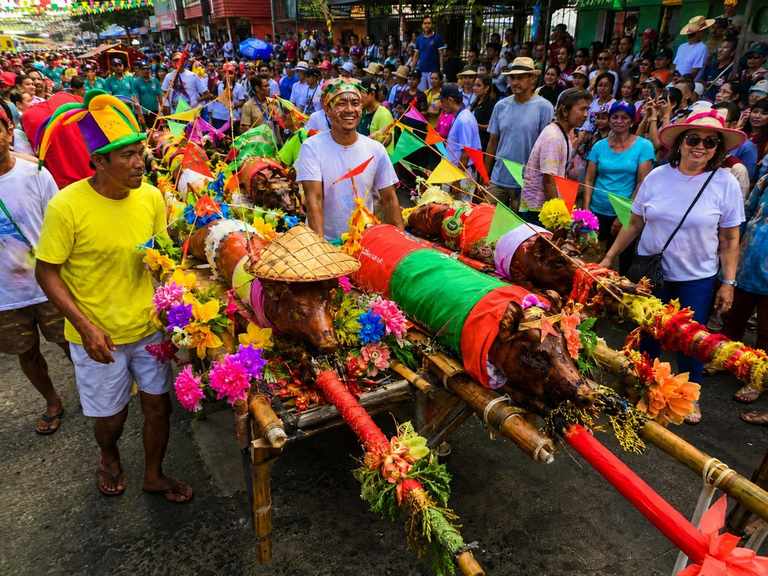
Parada ng Lechon is Balayan's fiesta for St. John the Baptist, held every June 24 in this old town on the western coast of Batangas. Dozens of roasted pigs in costumes ride through the poblacion on bamboo litters and floats, and almost everyone along the route is armed with a pail, a hose or a water gun. Come expecting Mass at dawn, a parade by mid-morning, and clothes that will not stay dry for long.
It sounds like a joke festival until you learn where it comes from. The lechon in the parade started as thank-you offerings, carried to the plaza by families who felt the saint had looked after them that year. The costumes and the soaking came later, and the gratitude never left.
This guide explains the story behind the pigs, how the day runs, how to reach Balayan when half the town is closed to traffic, and what to pack so your phone survives the afternoon.
A thanksgiving that grew legs
The tradition belongs to Kanluran, the western part of Balayan's poblacion and once a working-class neighbourhood. Going back to the Spanish and American years, a household that had a good year would roast a pig and bring it to the plaza for San Juan Bautista, the saint honoured on June 24. Neighbours who could not spare a pig joined the walk anyway, which counted as their own way of saying thanks.
Each good harvest or new job meant another lechon on the road, and the procession slowly turned into the main event of the fiesta. In 1959, Kanluran elders set up the Hermandad San Juan Bautista, a brotherhood that has run the celebration ever since. A one-morning walk became a fiesta of about two weeks, with the June 24 parade still at its centre. The 2025 parade was counted as the 66th organised edition, and Republic Act 12249 now makes June 24 a special working day in Balayan every year.
How the day unfolds
Early Mass at Balayan Church
Fiesta morning opens with Mass at the Parish of the Immaculate Conception, the old stone church a short walk from the plaza. Regular morning Mass is around 6:00 AM, and the fiesta Mass fills up fast, so anyone hoping for a seat should be inside before then. Most visitors skip it, but it is the part locals care about most, and it gives the rest of the day its meaning.
The pigs come out
Once Mass ends, the floats line up. The count changes every year, usually somewhere between 50 and 70-plus lechon. In 2025 there were 71 entries, split into families, barangays, and businesses and civic groups.
The fun is in the dressing. You might see a lechon in a barong or a Filipiniana, another as a Katipunero, a few in sunglasses and wigs, one wearing a company uniform, and at least one dressed as a cartoon character or a pharaoh. They ride on carrozas, pickup trucks and hand-carried frames trimmed with banana leaves, flowers and balloons, while the owners walk alongside, dancing more than marching. A best-dressed lechon is usually judged, and a Lechon Queen is crowned at the anniversary ball in the plaza the night before.
Basaan: nobody stays dry
St. John baptised Jesus in the Jordan, so his feast day across the Philippines comes with basaan, the custom of dousing people with water. Balayan takes it seriously. Residents wait along the route with hoses, buckets, tabo and water guns, and the parade, the crowd, and anyone who wandered in wearing nice clothes all get drenched. Kids run riot, teenagers dance in the spray, and even police on duty end up wet.
Treat it as a blessing that happens to be fun. People generally leave elders, anyone holding cameras or electronics, and workers on the job alone. If someone waves you off, respect it. If you get a pail over the head, laugh. Getting splashed is the whole idea.
After the parade
When the floats finish, Balayan settles into a classic Batangas fiesta. Families open their homes to relatives and guests for lunch. The parade lechon are mostly for show at this point and get shared out later, so the pig you eat at someone's table is usually a different one. Around the centre, stalls sell lomi, tapang Balayan, kakanin and the town's famous bagoong, and live bands and dance contests keep the plaza busy into the evening.
Getting to Balayan on June 24
Balayan sits about 2.5 to 3 hours from Metro Manila on a clear day. On fiesta morning, budget more.
By bus or van: Buses bound for Balayan leave from terminals in Cubao, Buendia and Pasay, and vans also run from the Pasay area. Take the earliest trip you can, ideally leaving before 6:00 AM, since the parade tends to start around 9:00 AM. Jeepneys link Balayan with Lemery and Batangas City throughout the day, though street closures slow everything down on June 24.
By car: One common route leaves SLEX at Santa Rosa, climbs through Tagaytay and then drops down toward the Nasugbu and Balayan road. If you have time on the way home, our Tagaytay and Taal day trip guide has stops worth pairing with the drive. The poblacion closes to through traffic in the morning, so park in a designated area outside the centre and walk in. Rerouting plans usually go up on the Municipality of Balayan's Facebook page a few days before.
Before you go: what to pack and plan
Dress to get wet. Quick-dry shirts, shorts and rubber slippers or sandals work best. Leave a full set of dry clothes in the car or your room, and carry a spare in a dry bag.
Seal your valuables. Phone, cash and ID go in a waterproof pouch or a zip bag before you leave. Water-resistant phones still get wrapped, and camera users should bring a rain cover.
Claim a spot early. Locals settle along the route near the church and plaza by about 8:00 AM. Start times shift a little each year, so check the town's official page in the week before.
Roll your windows up early. Kids along the highway start splashing cars well before the town proper.
Carry small bills. Stalls, bottled water and tricycles all run on cash, and ATM queues get long on fiesta day.
Stay the night if you can. Balayan has few hotels, but Lemery and Calatagan nearby have more. Staying over lets you skip the afternoon exodus and spend the next morning on the western Batangas coast.
Plan for rain. June is wet season in Batangas, so a light rain jacket earns its place even if you are going to be soaked anyway.
Routes, entry numbers and any basaan rules change from year to year. The municipal tourism office can confirm road closures and Mass times closer to the date.
Making a trip of it
Parada ng Lechon is a good fit for anyone who likes fiestas that still feel run by the town rather than for the cameras. There is no stadium, no ticketed grandstand and no big dance competition. The centrepiece is a roasted pig carried as thanks, the same idea as in 1959, just with more sunglasses. It sits in the same family of devotional street festivals as the Moriones Festival in Marinduque, but wetter and with far more food.
Give yourself an extra day and the trip gets better. Walk the old poblacion around the church, head west to the Calatagan lighthouse or the beaches near Nasugbu, and stop for a cup of kapeng barako on the way out. Batangas coffee has its own place on our Philippine coffee trail, and it tastes better after a morning of being soaked.
Parada ng Lechon at a glance
- Date: June 24 every year, feast of St. John the Baptist
- Place: Balayan poblacion, Batangas, around the plaza and the Immaculate Conception church
- Organised since: 1959, by the Hermandad San Juan Bautista
- Main events: early Mass, costumed lechon parade, basaan, open houses, bands in the plaza
- Status: special working day in Balayan under RA 12249
Bring a dry bag, an empty stomach and a good attitude about water. Balayan does the rest.
Comments
No comments yet. Been here recently? Share a tip or ask a question.
Leave a Reply