Simbang Gabi 2026 runs for nine mornings, from Wednesday, 16 December to Thursday, 24 December. The first dawn Mass is on the 16th, and the evening version starts a night earlier, on Tuesday, 15 December. Most parishes hold the dawn Mass at around 4 a.m. and the evening Mass between 7 and 8 p.m., though every church sets its own times.
That is the short answer. The longer one is worth knowing too, because this year's calendar has a wrinkle: the fifth morning lands on a Sunday, and that Mass looks and sounds different from the other eight. Below is the full date list, what actually happens at a Simbang Gabi Mass, and a few things that make nine early alarms easier to survive.
The tradition goes back to the Spanish period. The story most often told is that priests held the Christmas novena before sunrise so farmers could hear Mass and still reach the fields early, during the harvest months. Four centuries later the farmers are mostly office workers, students and call-centre agents, but the hour has stayed.
The Simbang Gabi 2026 calendar
Here is how the nine Masses fall this year. If you prefer the evening schedule, attend the Mass on the night before each date in the list.
Nine dawn Masses, December 2026
- 1st: Wednesday, 16 December (evening Mass on Tuesday, 15 December)
- 2nd: Thursday, 17 December
- 3rd: Friday, 18 December
- 4th: Saturday, 19 December
- 5th: Sunday, 20 December, the Fourth Sunday of Advent
- 6th: Monday, 21 December
- 7th: Tuesday, 22 December
- 8th: Wednesday, 23 December (last evening Mass of the series)
- 9th: Thursday, 24 December, Christmas Eve, a special non-working day
Two dates deserve a note. On Sunday the 20th, the Simbang Gabi Mass is also the regular Sunday Mass, so the Saturday-evening Mass on the 19th doubles as the Sunday vigil. Parishes are busier than usual that weekend, and the Sunday readings are used instead of the novena readings.
The 24th is the other one. After the last dawn Mass, the day carries on into Christmas Eve, and the evening brings separate Christmas Masses that are not part of the nine. Christmas Eve is a special non-working day for 2026 and Christmas Day is a regular holiday, so expect lighter traffic in the morning and heavier crowds at night.
Dawn Mass or evening Mass: which counts?
Both. In everyday Filipino use, "Simbang Gabi" covers the evening Masses from 15 to 23 December as well as the dawn Masses from 16 to 24 December. The dawn series is the older form and the one people mean when they talk about waking at 3 a.m. The evening series grew because a lot of people simply cannot do a pre-dawn Mass for nine days and still work a full shift.
Pick one track and stay on it if you are aiming for all nine. Mixing is common, but it gets confusing: an evening Mass on the 18th belongs to the 19th, so an evening on the 18th followed by a dawn Mass on the 19th is the same day twice.
Malls have joined in as well. Several chains hold evening Simbang Gabi Masses in their atriums or event halls, which suits people who want air-conditioning, easy parking and dinner straight after. Check the mall's social media pages in early December for the schedule.
What happens at a Simbang Gabi Mass
The structure is the ordinary Catholic Mass, so anyone who has been to one will recognise it. A few things set these nine apart from the rest of Advent.
- White vestments and the GloriaAdvent is normally violet and quiet, without the Gloria. Simbang Gabi Masses are votive Masses in honour of the Virgin Mary, so the priest wears white and the Gloria is sung. The Sunday on the 20th is the exception and keeps the violet.
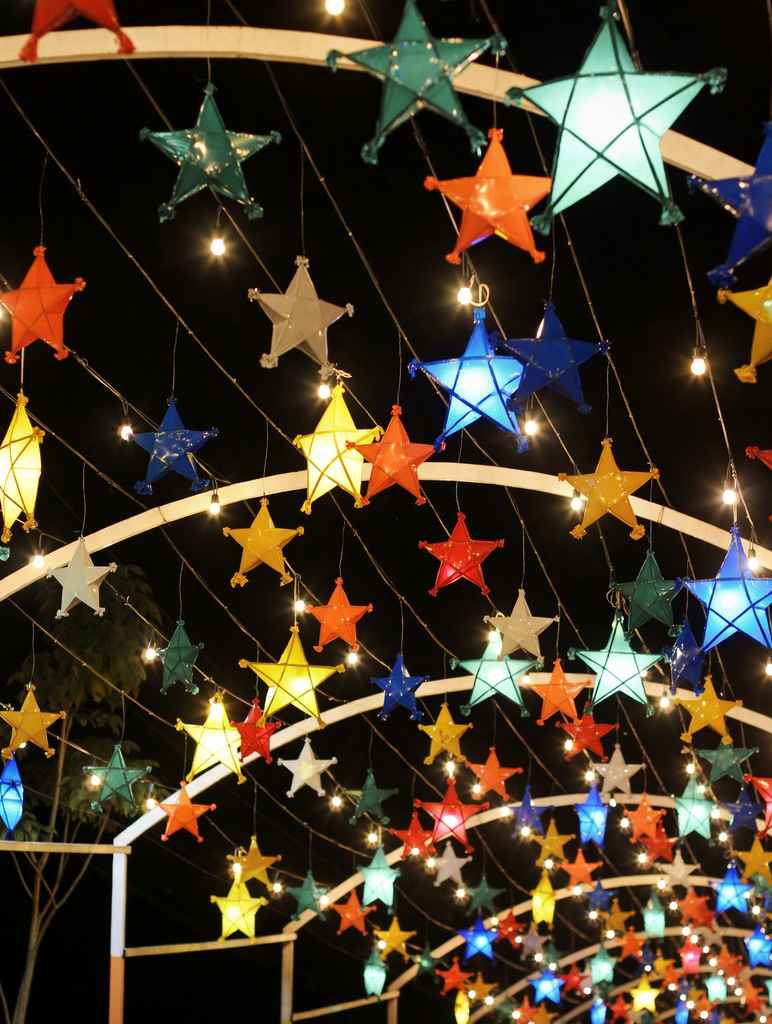
- A church dressed for ChristmasParol lanterns hang from the ceiling, the belen is set up near the altar and the choir sings Christmas songs even though the feast itself is still days away.
- A novena with a wishPopular belief says that if you finish all nine Masses, God grants a special request. The Church does not teach this, but plenty of people keep count anyway.
- About an hourMost Masses run 50 to 70 minutes. A 4 a.m. Mass usually lets out around 5, still dark, which is when the food stalls outside are busiest.
You may also hear the series called Misa de Gallo, the "rooster's Mass". Strictly speaking that name belongs to the Christmas Eve midnight Mass in the Spanish tradition, and the dawn novena was historically known as the Misa de Aguinaldo. Nobody at the church door will correct you either way.
The practice also had to be approved to survive. In 1953 the Philippine bishops asked the Vatican to let the novena continue, and Rome granted the request, a privilege it renewed in 1961. That is part of why the Philippine version has its own liturgical rules.
The breakfast after
For a lot of families the food is half the point. Vendors set up outside churches before the first Mass starts and stay until the crowd thins.
Bibingka is the classic: a rice cake baked in a clay pot lined with banana leaf, with coals both under and over it, often topped with salted egg and grated coconut. Puto bumbong is the purple one, sticky rice steamed in bamboo tubes and served with butter, coconut and muscovado sugar. Wash either down with salabat, a hot ginger drink, or thick tsokolate. Prices are modest, but bring small bills and coins, since a 4:50 a.m. vendor rarely has change for a ₱1,000 note.
If you are spending the season in the south, our guide to Christmas in Cebu lists churches and night markets around the city, and the Christmas in Dumaguete guide covers the cathedral and the boulevard.
How to make it through nine early mornings
Before the first alarm
- Check your parish's times by early DecemberSchedules go up on parish Facebook pages and bulletin boards. Large churches often add extra Masses, so the 4 a.m. one is rarely the only choice.
- Arrive 20 to 30 minutes earlyCathedrals and popular shrines fill up fast, especially on the first night, the weekend of the 19th and 20th, and the last two days. Late arrivals stand outside or sit on monobloc chairs in the yard.
- Sleep early, not lateThe middle of the novena is where the early alarms start to bite. Moving bedtime an hour earlier from the 14th helps more than an extra cup of coffee.
- Dress for the hourLowland churches are mild at 4 a.m. but crowded and warm inside. In Baguio or other upland towns it can be properly cold, so bring a jacket. Modest clothes are expected either way.
- Keep valuables closeDark streets, big crowds and phones out for photos make pickpocketing easier. Carry little, keep your phone in a front pocket, and walk with someone if the route is unlit.
- Plan the ride homeJeepneys and buses are thin before 5 a.m., and ride-hailing fares can climb when a big Mass lets out. Parking near cathedrals is tight, so walking or getting dropped off is easier.
If you miss a morning
Nothing official is lost. The novena is a devotion, not an obligation, apart from the Sunday Mass on the 20th, which counts for the usual Sunday duty. Many people who sleep through one dawn Mass simply attend that evening's anticipated Mass for the next day and keep going.
If you are travelling in December, the nine Masses are also an easy way to see a town at an hour most visitors never do. Pick a church with a history, go once, buy bibingka on the way out, and watch the street wake up while the parol lanterns are still lit. Those who want more lanterns afterwards can head north for the Giant Lantern Festival in Pampanga, which falls in the same weeks.
Comments
No comments yet. Been here recently? Share a tip or ask a question.
Leave a Reply