Caramoan sits at the far tip of its own peninsula in Camarines Sur, about 110 kilometers east of Naga City, and no flight lands in the town itself. That distance explains why the limestone islands off its coast still feel emptier than their Palawan cousins, and why most visitors burn a whole travel day just getting there.
For anyone starting in Cebu, the puzzle is real: there is no direct flight, no through ferry and no single ticket. This guide lays out the two sensible routes from Cebu, what an island-hopping day costs in pesos, which islands deserve your limited boat time and which months give you calm water instead of cancelled departures.
The islands became known worldwide as a Survivor location. Two consecutive seasons of the US edition were filmed here, along with versions from several other countries, and some of the same coves are still tour stops today.
Getting from Cebu to Caramoan
Two routes work. The first is a nonstop flight from Cebu to Bicol International Airport in Daraga, Albay, operated by the Cebu Pacific group in about 1 hour 15 minutes on most days of the week. You then continue north to Naga by bus or van. The second is Cebu to Manila, then Manila to Naga, with the Manila leg taking under an hour. The nonstop saves a flight but not the road, so price both on the day you book and check which days the nonstop runs.
The last stretch is the same either way. Buses leave Naga's central terminal for Caramoan along the Fuentebella Highway, take four to five hours and cost about PHP 270 to 350. A chartered van covers the same route for PHP 2,500 to 5,500 per vehicle. If you start in Manila instead, direct overnight buses run PHP 1,000 to 1,300 and take 11 to 14 hours. Skip this highway after dark: it has steep zigzags and unlit stretches above ravines, so aim to arrive in Naga the day before and take a morning bus.
Older guides describe a shortcut by boat from Sabang Port in San Jose to Guijalo Port in Caramoan. Passenger service on that crossing has changed, so treat it as a bonus rather than the plan, and ask your resort or the Caramoan tourism office before counting on it.
The islands worth the boat fare
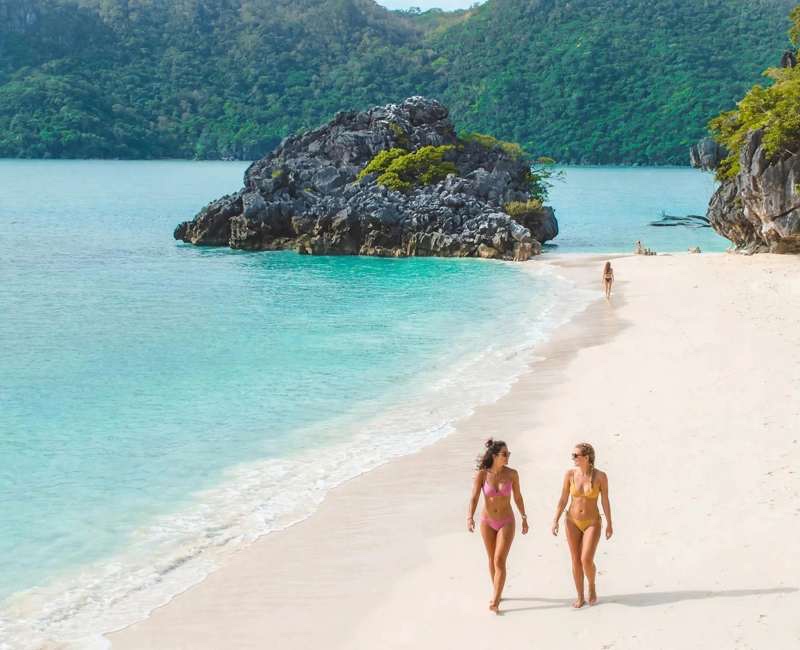
Boats leave from Paniman Beach or Bikal Port and fall into two circuits. The short trip covers Matukad, Lahos, Cagbalinad and Minalahos, all close to the jump-off. Matukad is the one to prioritize. It has fine cream sand, and a short, steep limestone scramble leads to a lagoon behind the beach, where locals tell stories of enchanted milkfish. The rock is sharp, so wear shoes with grip. Lahos shows two white beaches at low tide, while high tide covers the sand and opens swim-through caves.
The long trip reaches Guinahoan, Manlawi Sandbar, Cotivas and Sabitang Laya. Manlawi only appears at low tide, and Cotivas has a sandbar that shifts with the water. Boats on this circuit often leave as early as 7 AM to catch the right tide window, so a late start can cost you half the route. Most people split the two circuits over two days.
Not every famous cove is always open. Sabitang Laya, Gota Beach and Hunongan Cove close to tourists while a Koh-Lanta season is being filmed, sometimes for months. Message the Caramoan municipal tourism office on its Facebook page before you book anything.
What Caramoan costs in pesos
Boats are chartered per vessel, not per person, for up to six passengers. The short trip runs PHP 1,500 to 2,000, the long trip PHP 2,500 to 3,000, and the two combined start around PHP 4,000. Add the PHP 30 environmental fee paid at the Paniman registration desk and PHP 50 to 150 per island on arrival. For a group of six doing both circuits, that works out to roughly PHP 670 to 830 each for the boat and about PHP 850 to 1,300 once fees are included. This is an estimate, and it moves with how many islands charge.
Beachfront rooms near Paniman run about PHP 1,000 to 2,000 a night, while resorts such as Tugawe Cove start higher, at around PHP 3,750 for a cabin. Flights are the swing cost, so price those first. On top of them, budget roughly PHP 540 to 700 for the Naga to Caramoan bus round trip and PHP 100 to 300 per vehicle for tricycles to the jump-off.
Plan on cash. There is one ATM in town and it can run dry on busy weekends, while boatmen and tricycle drivers do not take GCash or cards. Carry PHP 20, 50 and 100 bills. Smart has the best signal, and Globe tends to fade behind the limestone and out on open water.
The best months for Caramoan
November to May is the usable window, and March to May is the calmest for the long circuit. Holy Week and late March through April bring the biggest crowds. November, December and February are quieter. From June to October the southwest monsoon swells often cancel the long route, and typhoon risk peaks in September and October. The short circuit near Paniman is more sheltered, but leave a spare day in your plans either way.
Check resort calendars too. Gota Village, one of the larger resorts, closes every year from October 12 to November 30, which is another reason December onward is the easier time to book.
Is the extra day from Cebu worth it?
Caramoan costs less on the water than a private boat in northern Palawan and sees far fewer visitors, but it asks for more time on the road. Our comparison of El Nido, Coron and Puerto Princesa helps if you are weighing the two. Plan four days rather than three, pack from the island hopping safety checklist and bring aqua shoes.
If you fly into Bicol International Airport, Albay is next door, and a morning at Mayon Volcano and Cagsawa Ruins can open or close the trip. Start your boat days at 7 AM and Caramoan rewards the effort.